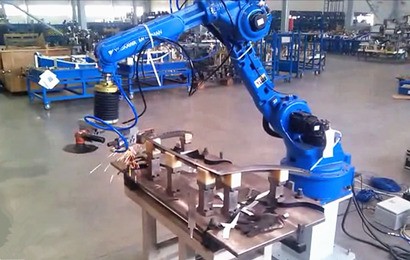
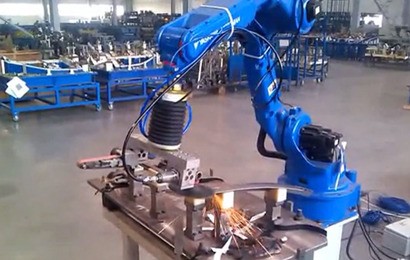
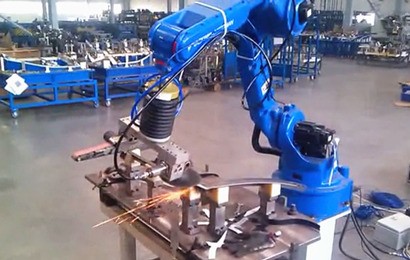
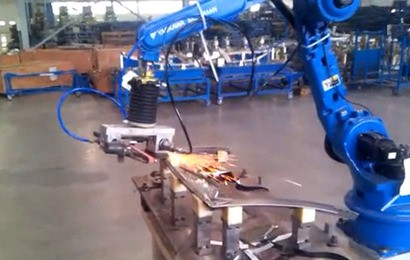
As essential sheet metal components of vehicle body-in-white structures, automotive car doors are fabricated by welding thin steel panels. After welding, weld seams inevitably generate weld beads, slag and welding spatter. The quality of weld grinding directly determines automotive door appearance, paint adhesion, sealing performance and overall vehicle assembly accuracy. Featuring thin sheet metal thickness, complex corners and R-angle structures, car doors also produce minor deformation after welding, bringing high requirements for precision finishing. The grinding process must completely remove weld scars and spatter while strictly avoiding over-grinding, sheet penetration and substrate damage.
Traditional car door weld finishing relies on manual angle grinders, with polishing quality fully dependent on technician experience. Manual grinding force is unstable, often resulting in incomplete weld cleaning with residual slag or over-grinding that causes sheet metal perforation and workpiece scrap. Narrow inner corners and curved angles are difficult to polish uniformly, leading to poor product consistency and high rework rates. Furthermore, massive metal dust degrades workshop conditions, while rising labor costs and unstable manual efficiency fail to meet the standardized mass production demands of automotive OEMs and component manufacturers.
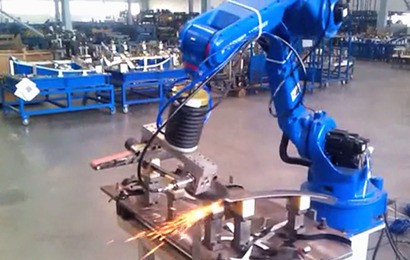
To solve typical processing pain points of automotive sheet metal welds, Truman has independently developed the dedicated automotive car door weld grinding workstation. As professional Truman grinding equipment, this intelligent grinding workstation realizes fully automatic weld seam finishing, providing high-quality surface pretreatment for subsequent automotive spraying processes.
Built on a 6-axis industrial robot and equipped with a floating force-control grinding spindle and sheet metal-specific polishing wheels, the system delivers high-precision robot grinding. After accurate positioning and clamping of automotive door workpieces, the robot follows preset weld trajectories for continuous finishing operations. The advanced floating force control unit dynamically adjusts contact pressure in real time, compensating for position deviations caused by welding deformation. It adaptively processes flat surfaces, corners and complex R-angle structures, efficiently removing weld beads, slag and spatter. With precise material removal control, the workstation prevents thin sheet penetration and ensures smooth, uniform weld transition surfaces.
The flexible tooling and fixture system is compatible with multiple car door models, supporting fast product changeover and simple on-site commissioning. Equipped with fully enclosed protective structures and professional dust collection systems, the workstation effectively collects metal grinding dust, controls pollution diffusion and reduces manual exposure to high-risk grinding operations.
This intelligent grinding solution reduces enterprise reliance on senior skilled grinding workers, greatly stabilizes automotive car door weld quality and improves production throughput. It minimizes sheet metal scrap and rework losses, providing automotive manufacturers with a mature, reliable and standardized intelligent post-weld processing solution for mass car door production.