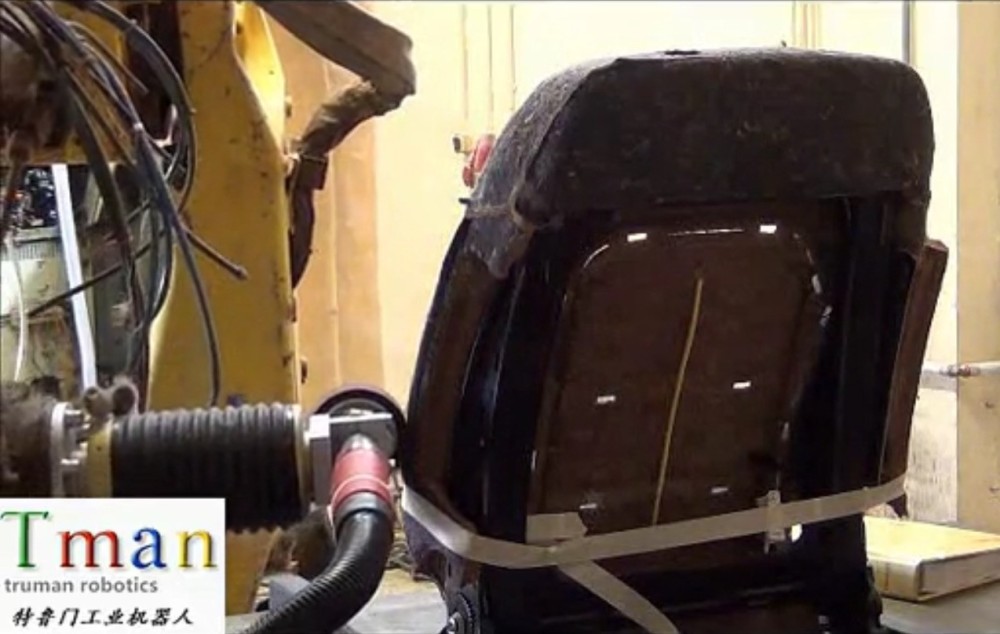
Automotive seat metal frames are assembled by welding steel tubes and sheet metal brackets. Welding processes on backrest frames, cushion frames and slide rail connecting brackets inevitably produce weld beads, welding slag and spatter. Meanwhile, thermal welding deformation causes structural deviations on seat frames. The grinding quality of automotive seat components directly affects subsequent paint adhesion, assembly accuracy and overall seat safety performance. Composed of thin-walled tubes and sheet metal parts, seat frames feature complex bent pipes, dense corners and narrow groove structures. The precision finishing process requires complete removal of welding defects and burrs while strictly controlling material removal volume, effectively preventing tube penetration and structural strength damage caused by over-grinding.
Traditional finishing of automotive seat frames relies entirely on manual handheld grinding tools. Dispersed weld seams, inner bent pipe areas and hidden corner grooves are difficult for workers to polish thoroughly. Unstable manual grinding force commonly leads to residual welding slag, thin tube perforation and uneven surface grinding textures, resulting in poor product consistency and extremely high rework and scrap rates. In addition, metal dust and noise generated during grinding create harsh working environments. High labor intensity, shortage of skilled polishers and rising labor costs make manual processing unable to meet the standardized mass production requirements of automotive component manufacturers.
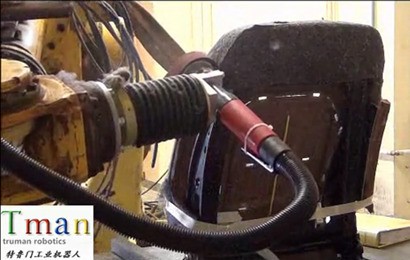
Targeting the core pain points of post-weld treatment for automotive seat frames, Truman has independently developed the professional automotive seat grinding workstation. As high-performance Truman grinding equipment, this intelligent grinding workstation realizes automatic weld grinding and deburring for all types of automotive seat metal frames and bracket parts, providing high-standard surface pretreatment for subsequent spraying processes.
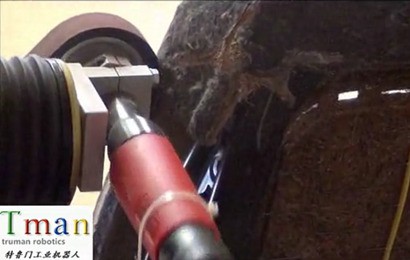
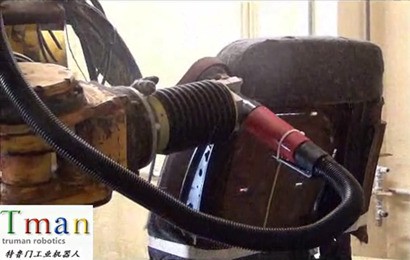
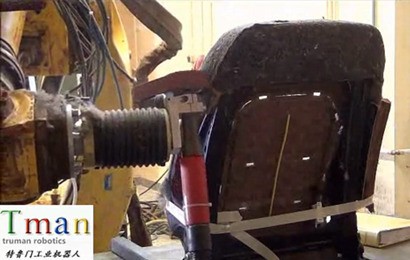
Centered on a 6-axis industrial robot grinding system, the workstation is equipped with a floating force-control grinding spindle and professional grinding wheels customized for tubular and sheet metal materials. After accurate positioning and clamping of seat frames, the robot performs precise finishing according to the 3D contour of workpieces, covering splicing welds, bent pipe corners, R angles and bracket edges. The advanced floating force control unit dynamically adjusts contact pressure in real time, compensating for position errors caused by welding deformation and clamping deviation. It adaptively fits flat surfaces, curved surfaces and narrow grooves to efficiently remove weld beads, slag and spatter. Strict material removal control eliminates over-grinding and tube penetration risks, achieving smooth weld transition and uniform overall frame surface quality.
The flexible fixture tooling system boasts strong compatibility, supporting multiple models of automotive seat frames and slide rail brackets with fast product switching and simple on-site commissioning. Equipped with a fully enclosed protective room and centralized dust collection system, the workstation thoroughly collects metal grinding dust, controls dust diffusion and isolates workers from high-risk grinding operations.
This intelligent grinding solution reduces auto parts enterprises’ reliance on senior skilled grinding technicians, stably improvesautomotive seat frame finishing quality and production efficiency, and minimizes frame scrap losses. It provides a mature, reliable and standardized intelligent processing solution for post-weld grinding of automotive seat metal components.