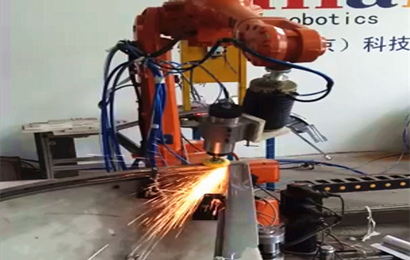
Car doors are manufactured from steel and aluminum panels through welding processes. After welding, welding slag, spatter and excess metal residues appear on weld seams. Grinding treatment is required to achieve smooth surfaces and meet exterior quality standards for finished vehicles. At present, most auto manufacturers still adopt manual grinding with flap discs, which brings prominent pain points to mass production.
Traditional manual grinding has obvious drawbacks. Workers suffer from high labor intensity and low working efficiency. Randomness in manual operation leads to inconsistent grinding accuracy. Workpiece scratches, uneven surface finishing and scrap loss frequently occur. Meanwhile, massive metal dust generated during grinding poses severe health risks to operators and creates potential safety hazards. Manual workflow can hardly satisfy the requirements of modern automotive mass production.
To tackle these industry challenges, our company has years‑long expertise in automated weld grinding. Based on extensive market research, data analysis, experimental testing and technology integration, we have independently developed the Car Door Weld Automatic Grinding Workstation.
Centered on an industrial robot and equipped with self‑developed full‑set intelligent software and hardware, this workstation features high‑level autonomous operation to realize fully‑automatic car‑door weld grinding and precise removal of welding slag and spatter. It adapts to both flat and curved weld seams on car doors with high grinding precision and outstanding consistency, eliminating defects caused by manual operation.
Compared with conventional processes, this automated workstation greatly boosts grinding efficiency and product qualification rate while stabilizing exterior quality of car doors. The enclosed automated working cell effectively controls metal dust pollution, optimizes workshop conditions, cuts labor cost and workpiece scrap loss. It delivers an efficient, safe and standardized intelligent solution for weld‑grinding procedures in auto‑parts manufacturing.